

UK Government experiences maritime technology in action at Ocean Infinity
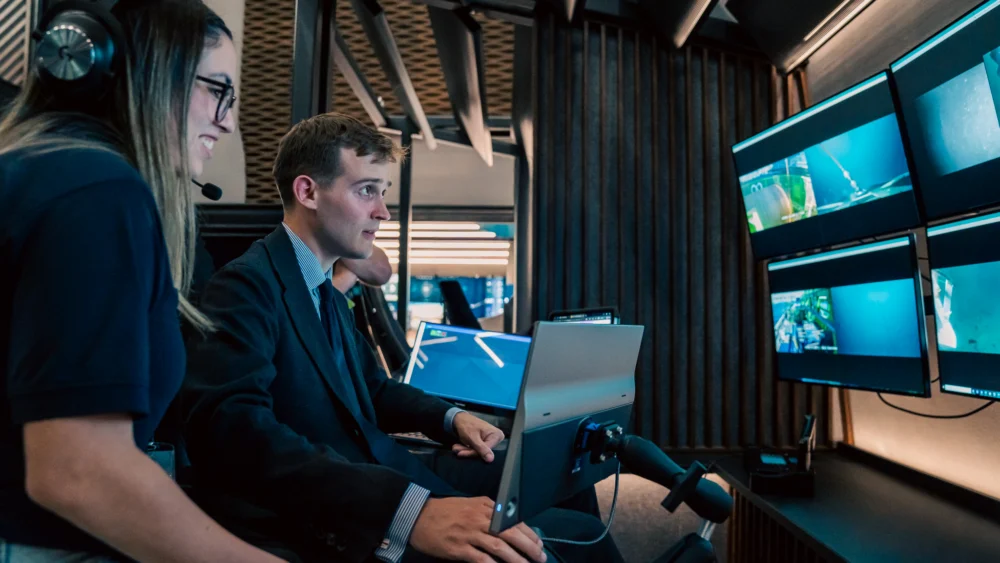
Business and Trade Secretary Peter Kyle and Maritime Minister Keir Mather visited Ocean Infinity in Southampton, where they experienced first-hand how robotics, software and autonomous systems are transforming the way work is carried out at sea. The visit formed part of a Government announcement focused on helping innovative technologies move more quickly from testing into real-world deployment.
The ministers met with Ocean Infinity’s leadership team and toured the company’s Operations Centre, where specialists oversee and support offshore activities around the world. During the visit, Maritime Minister Keir Mather took control of an underwater remotely operated vehicle operating off the Norwegian coast and, with little guidance, was able to manoeuvre a node on the seabed using a robotic arm.
While seemingly simple, the demonstration highlighted a much larger shift taking place across the maritime sector.
Ocean Infinity’s approach to remote operations is not simply about moving vessel-based activities from offshore to onshore. It is about fundamentally redesigning how work is carried out. By combining robotics, software and autonomous systems, the company is creating operating models that can reduce offshore exposure, improve quality and efficiency, and enable a new generation of people to participate in maritime operations through technology-enabled roles based on land.
Ocean Infinity designs, develops and operates autonomous vessels, underwater robotic systems and the software platforms that connect them, supporting customers across offshore energy, defence, science and government sectors globally. The technologies showcased during the visit are routinely deployed in live operations around the world, helping organisations gather critical data, complete complex offshore missions and reduce the environmental impact of activities at sea.
Oliver Plunkett, CEO of Ocean Infinity, said: “We’ve been operating robots, fully uncrewed boats and lean-crewed ships at sea for a decade. We’ve overcome all of the technological challenges we’ve faced. But our success and our ability to continue to grow isn’t just a matter of technology. The role of people and regulation is just as important, probably more so. People have adapted and embraced the new jobs we’ve created, doing things that didn’t exist before. But regulation hasn’t moved as quickly.
The first step towards fully commercial, safe and long term sustainable use of robotics in the maritime industry is a practical and fast way to test and prove these systems safely in the real world. From there, if we get this right, the UK can build on its incredible heritage as a maritime nation to be the global leader, not just in developing the technology, but in actually putting it to work.
These reforms are a fantastic step. They give companies like Ocean Infinity the confidence to continue to invest, scale and deliver real capability from the UK into the global market knowing there is the clear support and encouragement of government and the regulator.”
The visit reinforced the UK’s potential to lead the next generation of maritime operations and highlighted the important role innovation, operational experience and effective regulation will play in accelerating the adoption of autonomous technologies.
For Ocean Infinity, the opportunity extends beyond technology alone. The company’s mission is to transform operations at sea through robotics, software and remote technology, reducing risk to people, minimising environmental impact and creating new ways for work to be delivered. The technologies demonstrated during the visit offered a practical example of that future already happening.